Observability, Detection, Audit, and Proof: How the Four Layers Fit Together
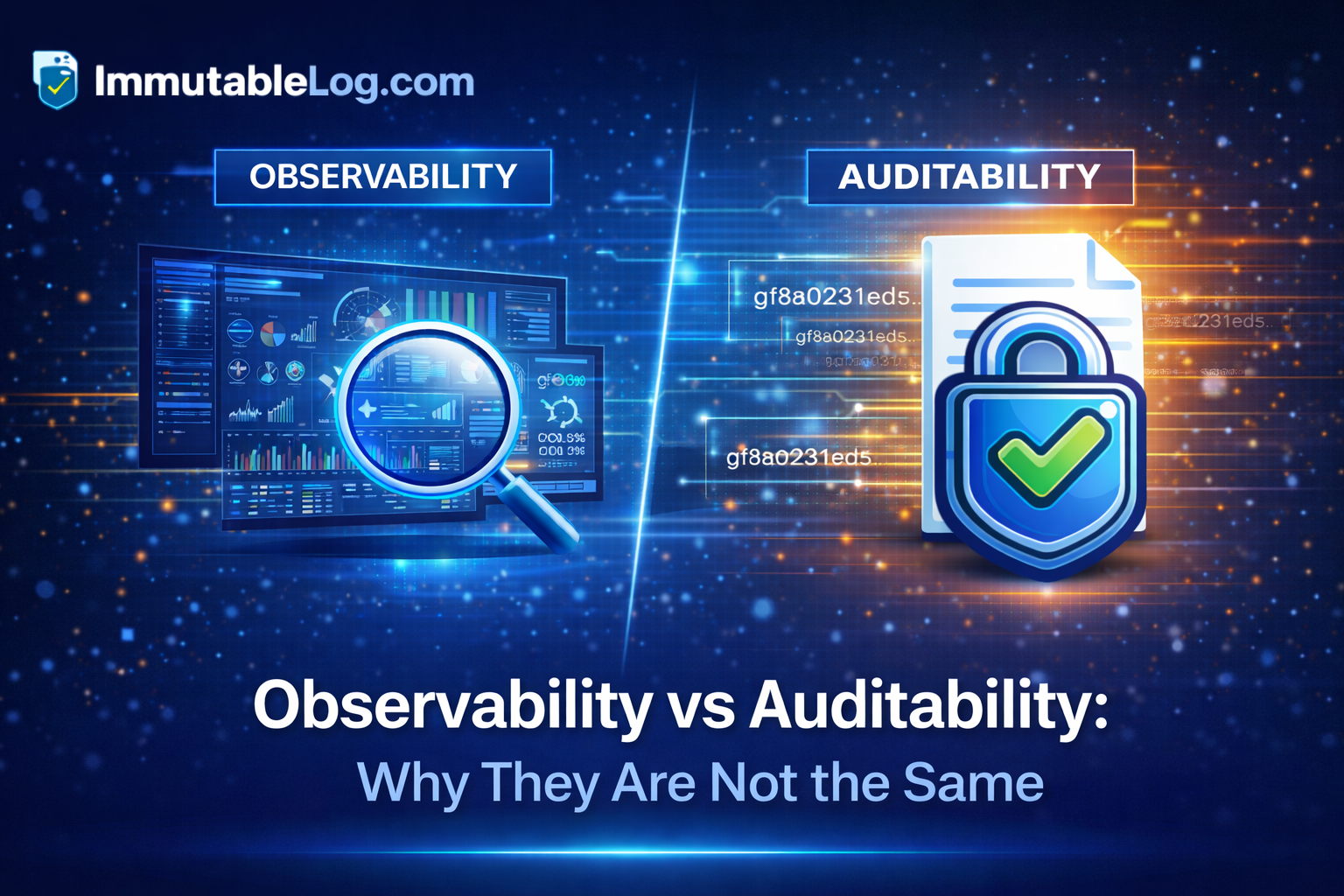
Observability tells you what your system is doing. Detection tells you when to look. Audit gives you a trail. Proof gives that trail a cryptographic guarantee a stranger can verify. Here is how the four layers build on each other.
Observe, Detect, Audit, Prove: Four Layers, One System
Observability platforms like Datadog, Elastic, Splunk, Grafana, and Honeycomb solved a real problem: understanding what a complex, distributed system is doing right now. Metrics, traces, and logs at scale, fast dashboards, alerting. That work matters, and it is not going away.
For years, the conversation stopped there, as if observability and cryptographic proof were two separate products for two separate audiences: engineers get dashboards, auditors get a different vendor entirely. That framing made sense when proof-of-integrity systems were niche and hard to operate. It does not describe how a modern audit and evidence platform actually works.
The more useful way to think about it is as a single pipeline with four layers: observe, detect, audit, prove. Each layer depends on the one before it. None of them replaces the others, and none of them is optional if your organization is regulated, sells into regulated customers, or simply wants to be able to answer "what happened, and can you prove it?" with confidence.
Observe: Understanding What the System Is Doing
Observability is the ability to understand the internal state of a system through its external signals.
- Metrics provide quantitative signals about system health, request rates, error rates, latency, and resource usage.
- Traces show how individual requests move across distributed services, helping teams identify bottlenecks and failure points.
- Logs record discrete events, user actions, system errors, and state changes. They form the narrative of what happened inside the system.
Together, these signals give engineering teams the visibility they need to operate complex systems reliably. This is the foundation everything else is built on: you cannot detect, audit, or prove an event you never observed in the first place.
Detect: Turning Signals Into Something Actionable
Raw observability data becomes useful the moment it triggers a rule that a human can act on. Detection is where a spike in failed logins, an unusual access pattern, or a privileged action outside a normal window turns into an alert instead of sitting unread in a dashboard.
Good detection depends on the same event stream that observability produces, evaluated continuously against rules tuned for the risks that matter to your organization: credential stuffing, privilege abuse, data exfiltration, configuration drift. Detection is what turns "we have logs" into "we noticed."
Audit: Building the Record That Survives Scrutiny
Auditability is a different requirement from either of the two layers above it. It is the ability to reconstruct, on demand, a complete and accurate record of what happened, who did it, and when, in a form that a skeptical third party, an auditor, a regulator, a security reviewer, can examine without having to simply trust the organization operating the system.
That requires the event stream to be organized, retained, and queryable as a continuous trail, not scattered across services with inconsistent retention policies. An audit trail is what you hand over when someone asks "show me everything that happened to this account over the last six months."
Prove: The Layer That Comes After
This is where cryptographic integrity enters, not as a competing category, but as the layer that sits on top of observe, detect, and audit, and answers the one question none of the three can answer on their own: can you prove this record has not been changed since it was written?
That requires specific architectural properties:
- Cryptographic integrity: each event is sealed in a way that makes undetected modification mathematically infeasible.
- Chain of custody: events are linked in a tamper-evident sequence, so deleting, inserting, or rewriting records becomes detectable.
- Independent verifiability: a third party can verify the integrity of records without relying on the system operator.
- Immutability: once written, records cannot be silently altered or deleted, even by privileged users.
A platform that only observes, detects, and audits can still tell a very good story about what happened. It just cannot prove, to someone who has no reason to trust it, that the story has not been edited. Proof is what closes that last gap, and it is meant to sit on top of the first three layers, not replace them.
Where the Gap Becomes a Real Problem
For many organizations, the difference between having a good story and having proof remains invisible during normal operations. It becomes visible when the stakes are highest.
Scenario 1: The Regulatory Audit
A financial services company has solid observability and a well-organized audit trail. A regulator requests evidence that access to customer financial data was properly controlled and logged over the previous 12 months.
The team exports the trail without difficulty, the observe, detect, and audit layers did their job. Then the regulator asks: "Can you prove these records have not been modified since the events occurred?" Without a cryptographic seal on each event, the honest answer is that the records are probably accurate, backed by access controls and internal trust, not proof.
Scenario 2: The Enterprise Security Review
A SaaS company is closing a deal with a large enterprise customer. During the vendor assessment, the customer's security team asks: "How do you prove that your administrators cannot cover their tracks if they access our data?"
Good logging and a clean audit trail get most of the way to a confident answer. What finishes it is a record that is cryptographically sealed at write time, so that anyone with sufficient privileges over the logging layer, including your own team, cannot quietly rewrite history without it being detectable.
Scenario 3: The Incident Investigation
A breach is discovered. The forensics team needs to reconstruct exactly what happened. Observability and detection got the investigation started fast, alerts fired, logs were available, the timeline came together quickly.
But what if the attacker, or a malicious insider, had enough access to modify or delete log entries before the investigation began? With a tamper-evident chain underneath the same trail, that kind of manipulation becomes detectable instead of invisible.
The Technical Difference in Practice
The core technical difference comes down to the underlying data model.
In a typical mutable data store, a log entry is stored as a row or document that, with sufficient privileges, may be updated, deleted, or purged, with no built-in mechanism to prove whether it was modified after ingestion.
In a tamper-evident system, each event is written together with a cryptographic hash derived from the event content and the hash of the previous event. This creates a chain in which any modification, no matter how small, changes the hash of the modified record and every record after it. An independent verifier can detect that break in the chain without needing to trust the custodian of the data.
This is not a feature that gets bolted onto observability tooling through a plugin. It is a property of how events are written in the first place, from the moment they are observed.
One Pipeline, Not a Choice Between Tools
This is not an argument for replacing Datadog, Elastic, Splunk, or similar platforms with something else. Plenty of organizations will keep using tools like these for day-to-day engineering observability, and that is a reasonable choice.
The point is that observing, detecting, auditing, and proving are stages of the same job, not four unrelated products competing for the same budget. An organization that stops at observability can explain what its systems did. An organization that adds detection can notice trouble early. An organization that adds a real audit trail can answer "show me everything." And an organization that adds cryptographic proof can do all of that and answer a skeptical outsider who has no reason to take its word for it.
For organizations in regulated industries, or those selling to regulated enterprise customers, stopping short of that last layer leaves a gap that auditors, regulators, and security teams are increasingly prepared to find.
Conclusion
Observability and auditability were never really in competition, and framing them as opposites obscures what actually needs to be built. Observability tells you what your system is doing. Detection tells you when something needs attention. Audit gives you a trail you can hand over. Proof gives that trail a mathematical guarantee that a stranger can check without trusting you.
Organizations that treat these as one pipeline, Observe, Detect, Audit, Prove, are the ones that build compliance readiness into their architecture from the start, instead of trying to retrofit proof into systems that were only ever designed to provide visibility.
See how ImmutableLog takes you from observing events to proving them. Talk to us →