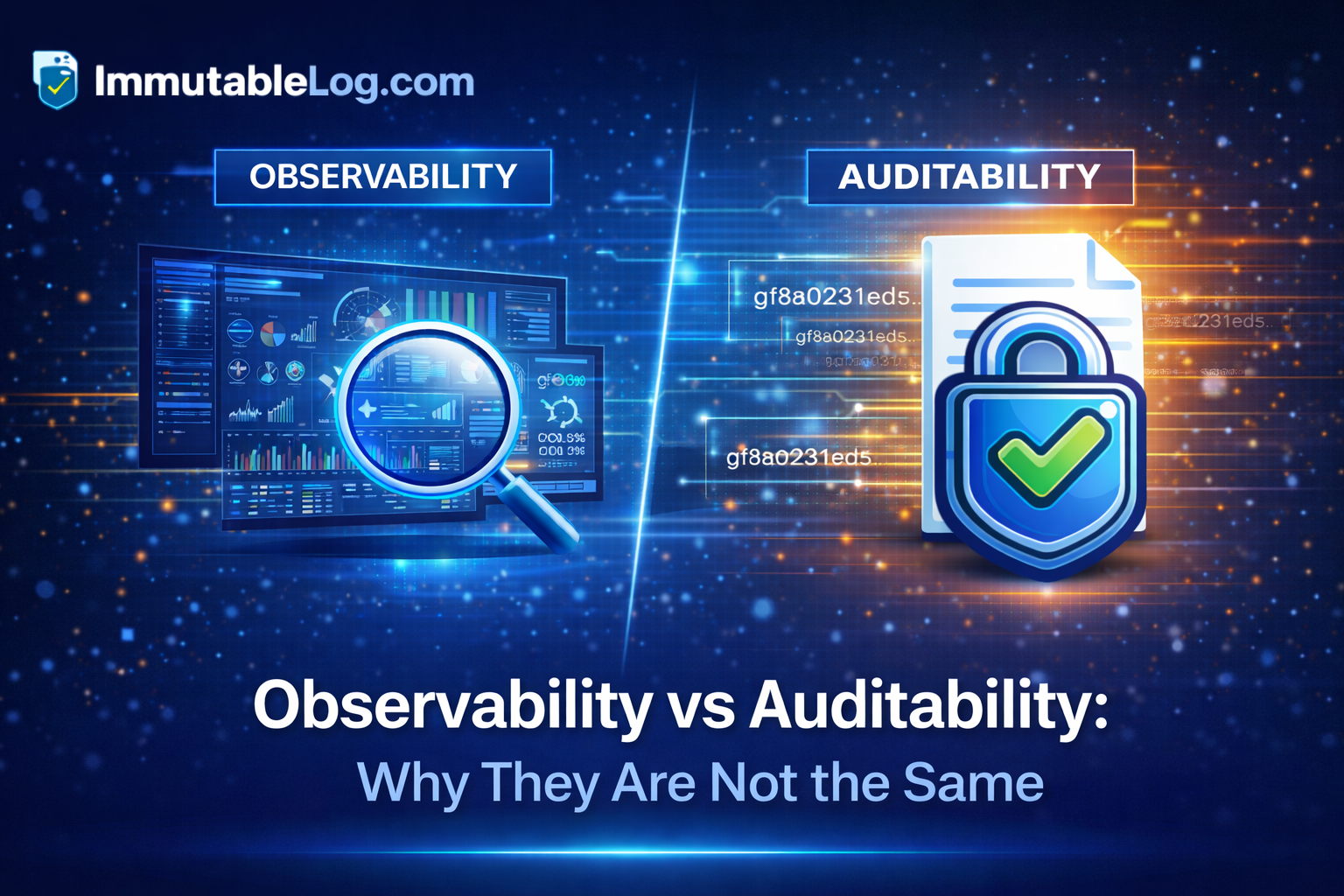
Why Traditional Logs Cannot Be Trusted in Critical Systems
Traditional logs help teams debug and investigate. But they cannot provide proof. Here is why mutable logging systems fail when integrity matters most.
The False Sense of Security in Your Logs
Every engineering team has them. Terabytes of log data flowing through Elasticsearch, CloudWatch, or a homegrown aggregator. Application events, access records, database mutations, all timestamped, searchable, and easy to query.
Logs are the backbone of operational visibility, and most teams naturally treat them as a source of truth.
But there is a critical distinction that often goes unnoticed until it is too late: a log is a record. It is not a proof.
The moment the question changes from "what happened?" to "can you prove what happened?" traditional logging systems begin to break down.
Logs Were Built for Observability, Not Evidence
Modern logging architectures were designed for a specific purpose: helping engineers understand and debug system behavior.
Logs are typically mutable by design. They are stored in databases or flat files that authorized users, and sometimes unauthorized ones, can modify, delete, rotate, or purge.
There is nothing inherently wrong with that for operational use. But the requirements change completely when a compliance auditor, regulator, enterprise security team, or legal department asks for verifiable evidence.
- An observability system helps explain what the system recorded at a given time.
- A proof system makes it possible to verify that what you are looking at was not altered afterward.
Traditional logs satisfy the first requirement. They fail the second.
Anyone with Sufficient Access Can Alter a Log Record
This is uncomfortable to state plainly, but it is true: in most organizations, a sufficiently privileged user can alter a log entry without leaving visible evidence.
Consider the standard architecture. Application events are written to a relational database or document store. Engineers, DBAs, and DevOps teams often have direct access to those systems. A row in a user_events table is still just a row. An UPDATE or DELETE statement works on a log record the same way it works on any other record.
PostgreSQL, MySQL, MongoDB, and Elasticsearch do not, by default, make log entries cryptographically tamper-evident. A timestamp can be changed. The actor field can be overwritten. The event can be removed entirely.
More importantly: in a traditional mutable system, there may be no reliable way to prove that this happened.
The log that was supposed to be your source of truth becomes a source of uncertainty.
Real-World Failure Modes
- Post-incident alteration: A security incident is discovered, and someone with database access removes or edits the log entries linked to their account before the investigation begins.
- A DBA covering tracks: A privileged database administrator makes unauthorized changes to sensitive records, then edits the audit log to hide the evidence.
- Rotation and deletion: Logs are rotated after 30 or 90 days. An auditor later asks for proof of access from six months ago. The data is gone.
- Compliance audit failure: A regulator asks for evidence that a user accessed a specific record on a specific date. The engineering team provides a log entry. The regulator asks: "How can I verify this record has not been modified?" There is no defensible answer.
The Distinction That Changes Everything: Record vs. Proof
A record captures what happened. A proof provides a mathematical guarantee that the record has not been altered since it was written.
This is not a philosophical distinction. It has direct legal, regulatory, and commercial consequences.
Under frameworks such as SOC 2, ISO 27001, HIPAA, and LGPD, organizations increasingly need to demonstrate not only that they collect logs, but that those logs are trustworthy.
Auditors are becoming more technically rigorous. Saying "we have logs" is no longer enough. The real question is: "Can you prove those logs are accurate?"
A cryptographically tamper-evident logging system addresses this by chaining each new event to a hash derived from previous events. Altering any record changes the chain in a way that becomes detectable to an independent verifier.
That is what transforms logging from operational evidence into defensible proof.
What Tamper-Evidence Means in Practice
A tamper-evident log is not simply a log protected by stronger access control.
Access controls matter, but they can be bypassed, misconfigured, or abused. Credentials can be stolen. Insiders remain a recognized risk in every serious security model.
Tamper-evidence means:
- Each event is cryptographically sealed at the moment it is created, using a hash derived from the event content and the preceding record.
- The sequence is independently verifiable, so any third party can detect modification, insertion, or deletion.
- No single party can silently rewrite history: not the vendor, not the customer’s DBAs, not a compromised admin account.
This is the difference between a log you can search and a log you can defend in a courtroom, in a regulatory review, or during an enterprise security assessment.
The Operational Reality
Most teams do not discover the weakness of their logging architecture during routine operations.
They discover it in a crisis: during a breach investigation, a legal dispute, a surprise audit, or a vendor security review where an enterprise customer demands proof of access controls.
At that point, the engineering team usually has only two possible answers:
- They have tamper-evident logs and can provide cryptographic proof of what occurred.
- They have traditional logs and can only say: "As far as we know, this is what happened."
For regulated industries, enterprise buyers, and any environment where the integrity of access records matters, the second answer is not enough.
Conclusion
Logs are essential infrastructure. But treating traditional logs as sufficient proof of what occurred in a critical system is a category mistake.
They were built for operational observability, not for legal, regulatory, or evidentiary assurance.
The good news is that adding a tamper-evident audit layer does not require replacing your existing logging stack. It requires adding a purpose-built layer designed for proof, one that makes every relevant event cryptographically verifiable and independently defensible.
The organizations that build that layer before they need it are the ones that pass audits, close enterprise deals, and respond to incidents with far more confidence.
See how ImmutableLog helps teams move from logging events to proving them. Talk to us →