Privileged Access Monitoring for SaaS Teams: Watching the People Who Can Watch Everything
Admin and root accounts are the most powerful in your system, and the least monitored. Here is how to reconstruct who changed what, why a mutable log can't fully answer that question, and where detection and audit connect.
The Person Who Can Watch Everything Is the Person You Watch Least
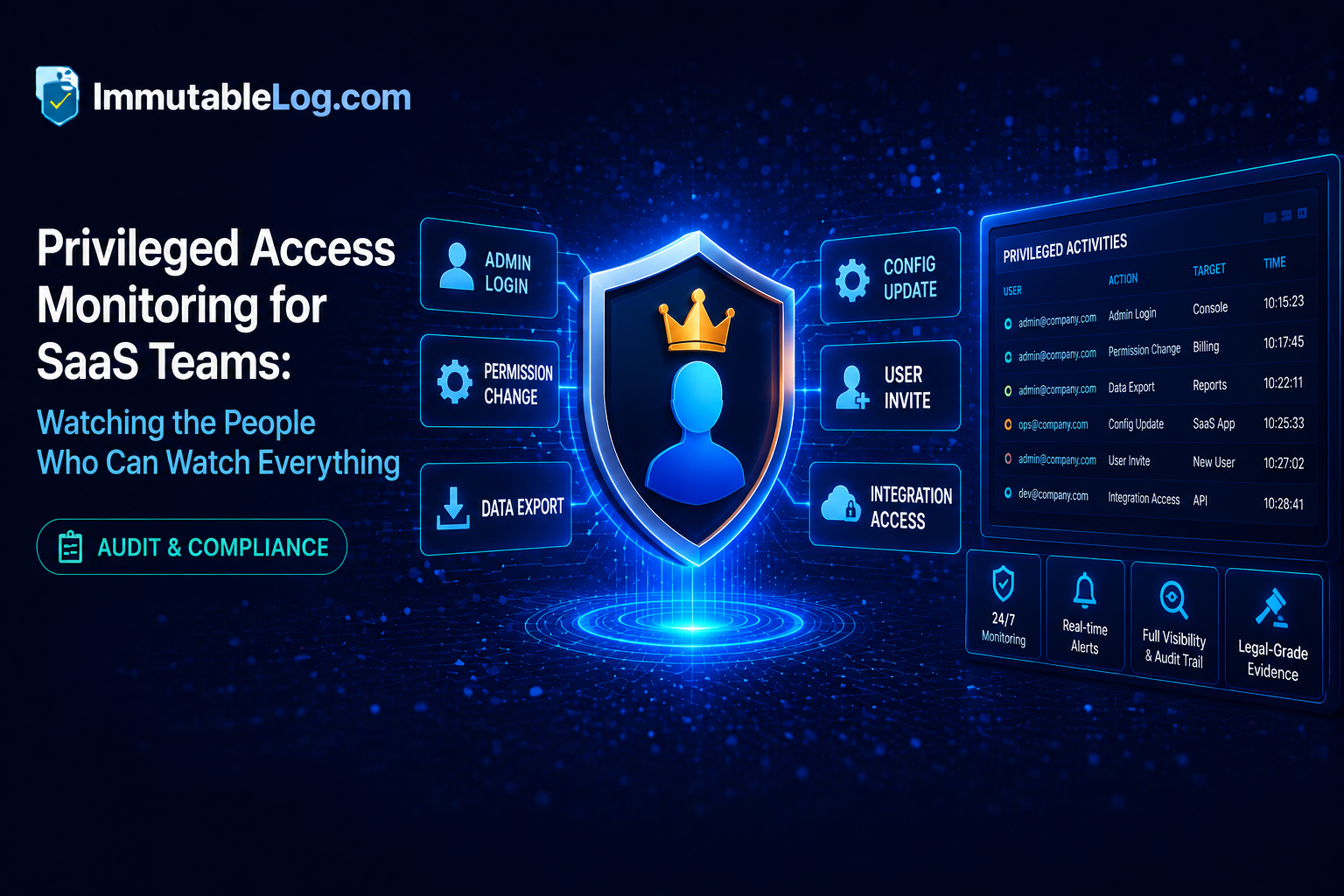
Every SaaS company has a small group of accounts that can do almost anything: change permissions, access any customer's data, modify billing, delete records, impersonate users for support. These accounts exist because someone has to be able to fix things when they break, and that is a legitimate operational need.
It is also the exact set of accounts an organization tends to monitor the least, precisely because they are trusted. Regular user activity gets logged, rate-limited, reviewed. Admin activity is often assumed to be fine by default, because the people holding those accounts are the ones the company trusts most.
That assumption is where the risk hides. A privileged account is not just powerful, it is also the account best positioned to make its own actions disappear from an ordinary log.
The Questions That Come Up, Always Later Than You'd Like
None of this shows up as a hypothetical scenario for most companies. It shows up as a specific question, asked at a specific moment, usually after something has already gone wrong or something has already been asked by someone the company cannot brush off.
- "Who changed this?" A configuration flips, a permission changes, a customer's plan gets modified without an obvious paper trail, and the first question is always who, exactly, made that change.
- "Was this admin activity suspicious?" An account with elevated access does something unusual, a large data export, an off-hours session, an action outside its normal pattern, and someone needs to determine fast whether it was routine or a problem.
- "Who changed this permission, and when?" During a security review or a customer's vendor assessment, this is one of the first questions asked, and "we're not entirely sure" is not an answer that survives the conversation.
Answering any of these requires two things at once: a record detailed enough to reconstruct exactly who did what, and confidence that the record itself has not been altered, including by the very people it is watching.
Reconstruction Requires the Right Shape of Record
Answering "who changed this" is not just a matter of having logs, it is a matter of having logs that carry the right fields, consistently, for every privileged action across every service.
A usable record of privileged activity needs, at minimum: the actor (which account, not just which service made the call), the action taken, the resource affected, the timestamp, and the origin (IP address, session context). Scattered across services with inconsistent formats, reconstructing a sequence of privileged actions turns into the same manual, cross-tool investigation that plagues general-purpose logging, except now the stakes are higher because the accounts involved can touch anything.
This is where the same event stream that makes general observability possible does double duty: privileged actions need to land in the same searchable, timestamped, consistently structured stream as everything else, filterable specifically by actor role or permission level.
Why a Mutable Log Doesn't Actually Answer the Question
Even with a well-structured record, one problem remains specific to privileged access: the accounts you are monitoring are often the same accounts with enough system access to edit or delete the monitoring data itself.
An admin with database access can, in a mutable system, quietly correct an audit table the same way they would correct any other operational data. Not necessarily out of malice. Sometimes it is an honest cleanup of a mistake. But the effect on the record is identical either way: the evidence that would have answered "who changed this" is gone, and nothing in a mutable system tells you it was ever there.
This is the same structural weakness that makes any mutable audit trail fragile, applied to the one category of account best positioned to exploit it. A privileged access record that can be quietly edited by a privileged account is not really a control. It is a record that trusts the exact people it exists to watch.
Where Detection and Audit Meet
This connects directly to the detection patterns that catch unusual privileged activity in the moment, an admin session outside normal hours, an action outside the account's typical pattern, a spike in privileged operations in a short window. Detection tells you when to look. The audit trail is what you look at once you do.
They depend on the same underlying event stream and reinforce each other: an alert that flags unusual admin activity is only useful if there is a detailed, trustworthy record behind it to investigate. And a detailed record is only fully defensible if nobody, including the privileged accounts it describes, can quietly edit it after the fact.
The Layer That Closes the Loop
Reconstructing who did what answers most day-to-day questions. But the hardest version of the question, the one a serious security review or a determined internal investigation eventually asks, is not "what does the record say happened," it is "can you prove the record itself wasn't changed by the very people it's about."
That is where a cryptographic seal on each event matters. It does not change how the record is built or searched. It changes what you can say about it afterward: that any modification to a historical entry, including by someone with database-level access, breaks a verifiable chain instead of disappearing without a trace.
This is not the main story for most day-to-day privileged access monitoring, most of the value is in the visibility and the detection working together. But it is the answer to the version of the question that shows up during a real security review, and it is worth having in place before that review happens rather than after.
Where ImmutableLog Fits
ImmutableLog captures privileged actions in the same normalized event stream as everything else, actor, action, resource, timestamp, and origin, searchable and filterable specifically for admin and elevated-permission activity. Detection rules watch that same stream for unusual patterns of privileged use, and every event is sealed cryptographically at write time, so the record of who did what stays trustworthy even against the accounts it is watching.
See how ImmutableLog helps SaaS teams keep a trustworthy record of who has access to everything. Talk to us →