What Your Logs Aren't Telling You: Event Observability for Small Engineering Teams
Small and mid-sized engineering teams don't have a compliance problem, they have a scattered-logs problem. Here is why event visibility has to come before detection or proof, and what a single searchable stream actually buys you.
The Question That Comes Up at 2:32 PM on a Tuesday
A customer reports that a request failed. Support asks engineering what happened. Engineering opens three different services, three different log streams, and starts grepping for a timestamp that may or may not line up across systems with slightly different clocks.
Twenty minutes later, someone finds the request. It hit the API gateway, got routed to the billing service, timed out waiting on a downstream call, and returned a 500. None of that was hard to figure out once the right logs were in front of the right person. Finding the right logs was the hard part.
This is not a story about a security incident. It is not a story about compliance. It is the ordinary cost of not having a single place to see what your system did, and it happens to small and mid-sized engineering teams every week.
Why This Gets Worse as You Grow, Not Better
Early on, a small team can often hold the system in their heads. One service, one database, one log file to tail. Debugging is fast because there is not much to search.
That stops working the moment the architecture grows past a service or two. A typical SaaS backend for a company in the 20-500 employee range usually has an API layer, a handful of background workers, a queue, and at least one third-party integration that also produces logs nobody centralized. Each of those writes to its own file, its own log group, or its own dashboard, if it writes anywhere durable at all.
Nobody decided this was the design. It is what happens when logging is an afterthought added service by service instead of a property the whole system has from the start.
The Real Cost Is Time, Not Just Frustration
The visible symptom is the debugging session that takes an hour instead of five minutes. The less visible cost is what that hour actually contains:
- Context switching across two or three different tools, each with its own query syntax, retention window, and access permissions.
- Timestamp reconciliation between services that log in different timezones or formats, so "what happened at 14:32" requires manual translation before anyone can even start searching.
- Guessing which service is involved before you can start looking, because there is no single place to search by request ID, user ID, or endpoint across the whole system.
- Losing the trail entirely when a service only retains logs for a few days and the customer reports the issue a week later.
None of this shows up on an engineering roadmap. It shows up as a slower incident response, a support ticket that stays open too long, and an engineer who has quietly become the one person who "knows where to look."
The Trigger Is Usually Small, and It Escalates
Teams rarely wake up one day and decide to build an observability strategy. The trigger is almost always something concrete and immediate:
- "We need better logs." Said after the third incident in a month where the postmortem took longer than the incident itself.
- "A customer asked for audit logs." Said after a prospect's security questionnaire asks a question nobody on the team can answer cleanly yet, well before anyone is thinking about formal compliance frameworks.
- "Can you tell me who called this endpoint and when?" Said by a customer, and answered with a shrug because the answer is scattered across three systems.
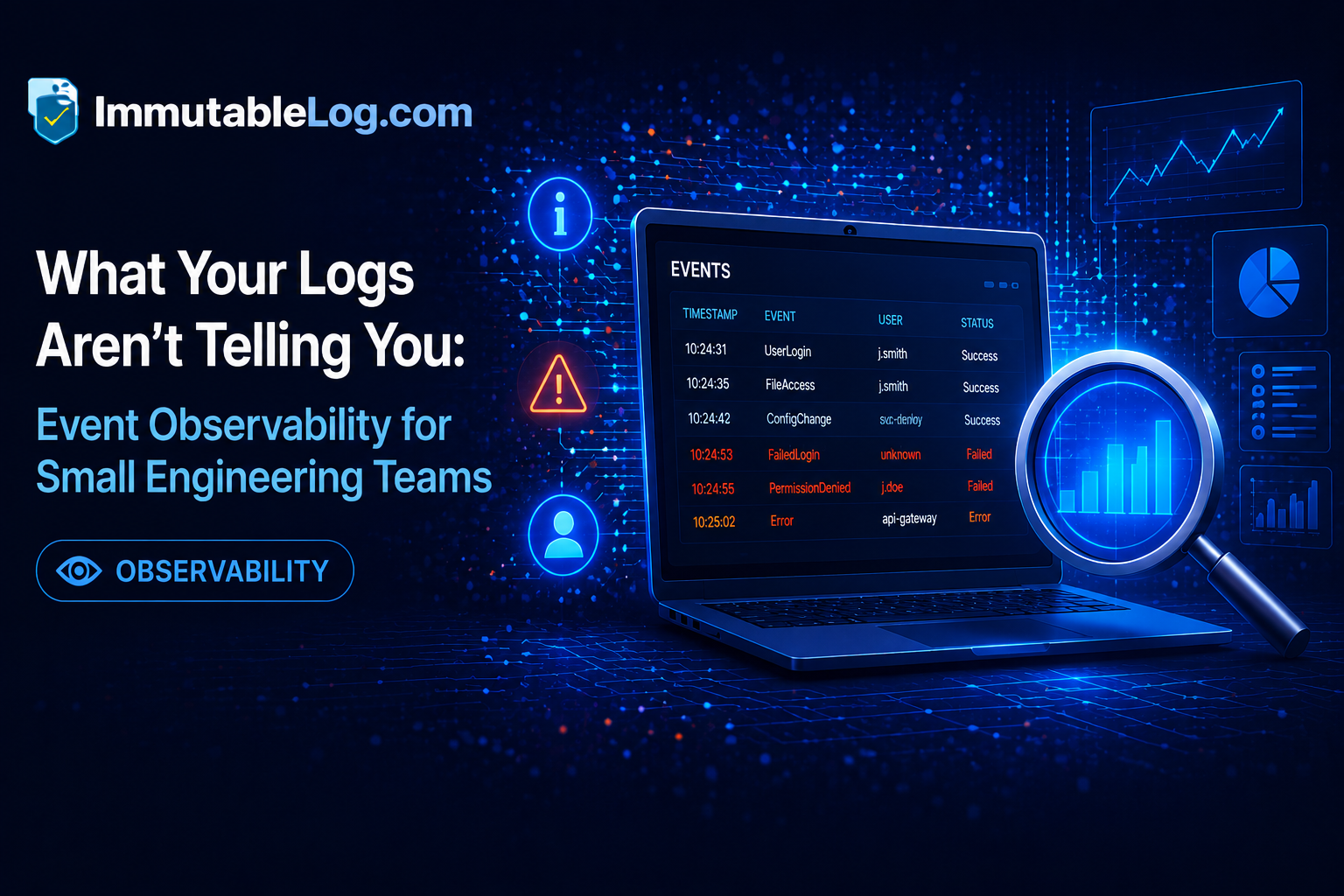
At this stage, the need is not detection, and it is not proof. It is visibility: a single place to search for an event, filter by service, environment, status code, or endpoint, and see a timeline instead of piecing one together by hand.
What a Single Event Stream Actually Buys You
The fix is not necessarily a bigger observability budget. It is consolidation: every event, from every service, landing in one searchable stream with a consistent shape.
- Search by what you actually know. A customer ID, a request ID, an IP address, a status code. You should not need to know which service to search before you can search.
- A real timeline. The sequence of events for one request or one user, ordered correctly, without manually reconciling timestamps across systems.
- Aggregation by service, environment, and status. A 500 spike on one service, in one environment, is a five-second query, not a five-tool investigation.
- Retention you control. The event that mattered should still be there when the customer reports it a week later, not aged out of a log group nobody was watching.
This is the layer that has to exist before anything else does. You cannot detect a pattern in events you never captured consistently, and you cannot audit a trail that only exists in fragments across systems with different retention policies.
Where ImmutableLog Fits at This Stage
ImmutableLog's event pipeline is built for exactly this problem: every event your services send lands in one normalized stream, searchable by service, environment, endpoint, status, actor, and time, with a timeline view instead of a pile of unrelated log lines.
That is the Observe layer, and it is deliberately the first one. It does not require you to have a security team, a compliance mandate, or a SOC. It requires having services that produce events and a team that wants to stop guessing which one to open first.
Detection rules that turn a pattern into an alert, and the cryptographic layer that turns a trail into verifiable evidence, both build on top of this same event stream. But you do not need either of those to get value from having one place to look. You need that today, the next time someone asks what happened at 14:32.
See how ImmutableLog gives engineering teams one place to search, filter, and trace every event. Talk to us →