
Merkle Trees Explained: The Backbone of Verifiable Data
Merkle trees make it possible to prove that a specific event belongs to a dataset without exposing everything else. Here’s why that matters for enterprise audit trails.
The Problem at Scale
A hash chain is a powerful way to prove that a sequence of records has not been altered. But it has a practical limitation: verifying a single record usually requires access to the full chain.
For an audit trail containing millions of events accumulated over years, that becomes inefficient. Proving one event can mean sharing, or recomputing, everything.
That creates a real enterprise problem. An auditor verifying a specific event from 18 months ago does not need access to every event from that period. A customer asking for proof that a particular data access occurred should not have to see the entire access log. Sharing full log history to answer a narrow question is operationally expensive and may create unnecessary privacy exposure.
Merkle trees solve this problem. They make it possible to prove that a specific event belongs to a dataset of millions of records without revealing or processing the rest.
What Is a Merkle Tree?
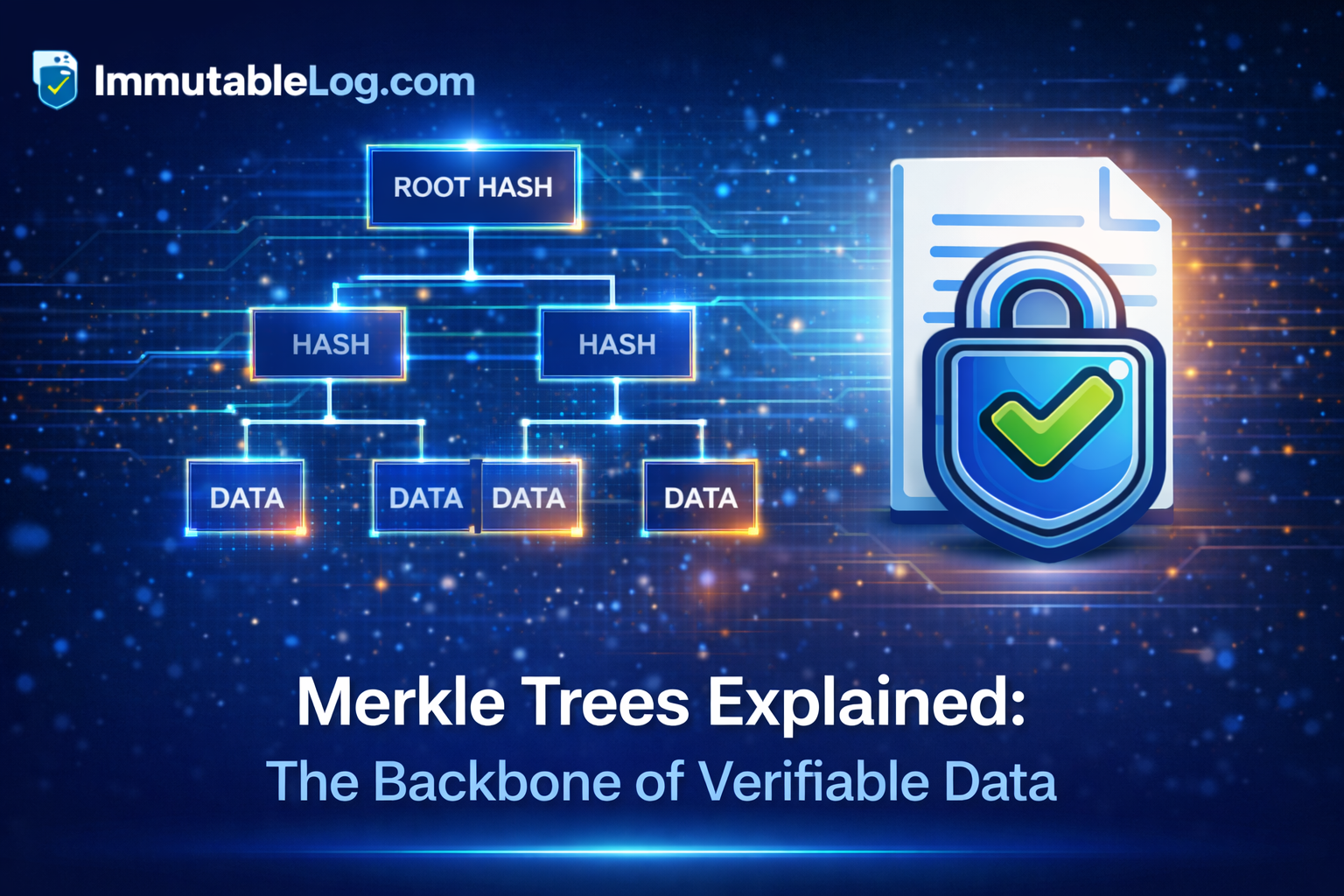
A Merkle tree, named after Ralph Merkle, who patented the concept in 1979, is a tree of hashes. Every leaf node is the hash of a record, and every parent node is the hash of its child nodes combined.
Here is how it works from the ground up.
Leaf Nodes
Start with a set of records, for example, eight log events. Each record is hashed individually. These hashes form the leaf nodes of the tree:
Leaf 1: Hash(Event_1)
Leaf 2: Hash(Event_2)
Leaf 3: Hash(Event_3)
Leaf 4: Hash(Event_4)
Leaf 5: Hash(Event_5)
Leaf 6: Hash(Event_6)
Leaf 7: Hash(Event_7)
Leaf 8: Hash(Event_8)
Parent Nodes
Pairs of leaf hashes are then combined and hashed again to form parent nodes:
Parent_A = Hash(Leaf_1 + Leaf_2)
Parent_B = Hash(Leaf_3 + Leaf_4)
Parent_C = Hash(Leaf_5 + Leaf_6)
Parent_D = Hash(Leaf_7 + Leaf_8)
Intermediate Nodes and Root
This process continues upward until only one hash remains:
Intermediate_E = Hash(Parent_A + Parent_B)
Intermediate_F = Hash(Parent_C + Parent_D)
Root = Hash(Intermediate_E + Intermediate_F)
That final value, the Merkle root, is a cryptographic fingerprint of the entire dataset. If any leaf changes, every hash on the path from that leaf to the root changes as well. The root becomes different.
The Key Property: Proof of Inclusion
The most important property of a Merkle tree is that it allows you to prove that a specific record is part of a dataset using only a small set of related hashes.
This is called a Merkle proof or proof of inclusion.
Suppose you want to prove that Event_3 is included in the dataset. You do not need to share every other record. You only need:
- The hash of Event_3 itself (
Leaf_3) - Its sibling hash (
Leaf_4) - The sibling hash at the next level (
Parent_A) - The sibling hash at the next level (
Intermediate_F) - The known root hash
With these values, anyone can recompute the path from Event_3 to the root and confirm whether it matches the published Merkle root.
If it matches, Event_3 is proven to be part of the dataset. If it does not, then either the record was altered or the proof is invalid.
This is what makes Merkle trees so efficient at scale. For a dataset with one million events, a Merkle proof requires only about 20 hashes. For a dataset with one billion events, it requires only about 30. The dataset grows linearly, but the proof grows logarithmically.
Why This Matters for Enterprise Audit Trails
Selective Disclosure Without Full Access
In enterprise audit scenarios, being able to prove that a specific event occurred, without exposing the full log, is often essential.
Consider a vendor security review. A customer asks for proof that their data was not accessed outside approved hours on a specific date. Sharing the full access log for that period might expose information about other customers, internal operations, or system design.
A Merkle proof makes it possible to prove the relevant fact without revealing the surrounding records.
The same principle applies to regulatory inquiries, contractual disputes, and legal discovery: prove exactly what was requested, without exposing what was not.
Tamper Detection at Any Point
If any record in the dataset changes, the Merkle root changes too.
That means an organization can publish or anchor the Merkle root externally, for example, in a public ledger, regulatory filing, or third-party escrow, and create a permanent point of reference. Any later attempt to alter the underlying records will produce a different root and can be detected immediately.
This is one of the reasons Merkle trees are so widely used in verifiable systems.
Bitcoin is a classic example. Each block contains the Merkle root of all transactions in that block. If even one transaction is altered, the root changes, which changes the block hash and invalidates the chain from that point forward.
Real-World Systems Built on Merkle Trees
Merkle trees are not theoretical. They are already part of the operational core of widely used systems.
Bitcoin and Ethereum use Merkle roots to protect transaction integrity inside blocks. Light clients rely on Merkle proofs to verify transactions without downloading the full chain.
Git uses a Merkle-like directed acyclic graph to ensure that changing a file changes the relevant tree and commit hashes.
Certificate Transparency uses Merkle trees to let anyone verify that a certificate was logged without downloading the entire log.
AWS QLDB and similar systems use Merkle-based verification to provide cryptographically verifiable document history.
Across all of these systems, the underlying value is the same: efficient, verifiable inclusion proofs with minimal overhead.
How ImmutableLog Uses Merkle Trees
ImmutableLog computes Merkle roots periodically over accumulated event records. Each Merkle root acts as a cryptographic fingerprint of all events recorded up to that point.
For any event in the log, ImmutableLog can generate a Merkle proof on demand. That proof allows an authorized party, such as a customer, auditor, or regulator, to independently verify that the event is part of the authenticated dataset without accessing unrelated records.
Those Merkle roots can also be anchored externally, creating a reference point that exists independently of the ImmutableLog platform itself.
That means even the system operator cannot alter historical records retroactively without detection.
From "Trust Us" to "Verify It Yourself"
Merkle trees change the relationship between the system that stores data and the people who depend on that data.
In a traditional system, an auditor asks for evidence and must trust that the evidence is genuine. The organization asks the auditor to believe that the logs were not tampered with.
With Merkle proofs, that changes.
The organization provides a proof. The auditor runs the verification. The result is deterministic.
The answer is no longer based on trust. It is based on cryptographic evidence.
That is what enterprise audit trails should provide: not assertions, but proof.
See how ImmutableLog helps teams move from logging events to proving them. Talk to us →