
When a Log Becomes Evidence: What Strengthens a System Record's Evidentiary Integrity
Not every log record survives serious scrutiny. Courts, arbitrators, and regulators evaluate evidence differently from engineering teams. Here is what strengthens a system record's evidentiary integrity, not a guarantee of admissibility, but a meaningfully stronger position.
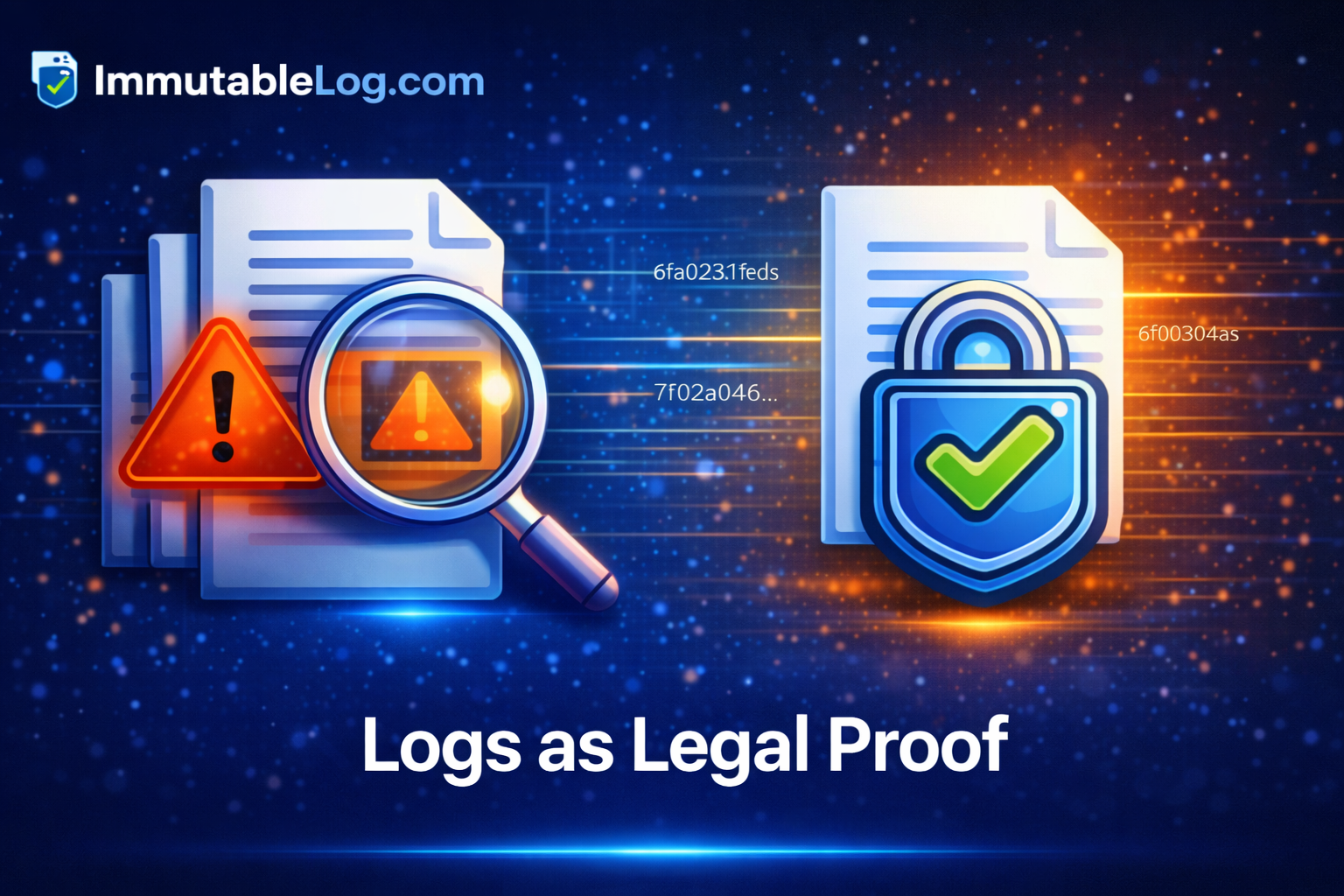
The Moment a Log Has to Stand on Its Own
Most teams design logging systems for operations: debugging, monitoring, and incident response. In that context, the log is an engineering tool.
But there is another scenario that rarely receives attention during architecture decisions and tends to surface at the worst possible moment: when a log record must stand on its own in a legal or regulatory setting, without the engineering team present to explain why it should be trusted.
That moment appears in chargeback disputes. In employment cases where system access is contested. In regulatory investigations into financial misconduct. In breach litigation where the sequence of events determines liability. In contract disputes where the core question is whether a specific party took a specific action at a specific time.
In each of these situations, the question is no longer what the log says. It is whether the log can be relied on as evidence.
What Legal and Regulatory Proceedings Actually Evaluate
Engineers often treat a log as trustworthy if the underlying system is trustworthy: solid access controls, secure infrastructure, reliable transmission, and standard operational safeguards.
Those properties matter operationally. But they do not automatically create legal credibility.
In formal proceedings, the standard shifts. The question is not whether your system is generally reliable. The question is whether this specific record could have been changed after the fact, and whether that possibility can be ruled out.
A judge or arbitrator does not need to prove that a record was modified. It is often enough to show that it could have been. Once that possibility exists, the evidentiary weight of the record drops. The party relying on it must then find additional support or accept that the outcome may turn on credibility instead of proof.
In many disputes, the opposing side does not need to disprove your record. It only needs to introduce doubt.
Three Cases Where the Difference Matters
Fintech Chargebacks at Scale
A payment company faces a wave of chargeback disputes. Cardholders claim that transactions were unauthorized. The company’s logs show that the transactions came from authenticated sessions with confirmed device fingerprints.
The cases move to arbitration. Opposing counsel argues that the logs were generated by the company’s own systems, stored in the company’s own infrastructure, and accessible to the company’s own technical staff. There is no independent verification showing that the records were not selectively altered to support the company’s position.
The arbitrators do not conclude that the logs were falsified. But they also cannot conclude that they were unquestionably intact.
The company settles a portion of the claims at a higher cost than it likely would have accepted if the records had been independently verifiable.
That cost difference never appeared in the logging budget. It appeared later, in legal outcomes.
Employment Dispute Over System Access
A financial services firm terminates an employee for cause, citing unauthorized access to confidential client data. The employee challenges the termination, arguing that the access logs were fabricated after the fact to justify a decision that had already been made.
The company presents logs showing the access events, complete with timestamps and user identifiers. The employee’s legal team asks for technical evidence that those records could not have been altered after the termination decision.
Under questioning, the company’s database administrators confirm that they had write access to the logging tables throughout the relevant period. They state that nothing was modified. But they cannot prove it.
The case settles. The settlement remains confidential. The company absorbs costs that likely would not have existed if the records had been tamper-evident from the moment they were written.
SaaS Platform in a Customer Contract Dispute
A B2B SaaS company enters a dispute with a former enterprise customer over an alleged service-level failure. The customer claims the platform was unavailable during a critical processing window. The company’s uptime logs show no downtime during that period.
The customer argues that logs stored inside the same environment under dispute carry an obvious conflict of interest. They ask for independent verification that the records have remained unchanged since the events occurred.
The company cannot provide it.
The dispute moves to arbitration. The logs are considered, but they are not treated as conclusive. The outcome depends on other evidence, much of it less precise.
What Changes When Cryptographic Integrity Exists
The properties that make a log record defensible are technical, not rhetorical.
First, each event must be hashed at write time. A cryptographic hash is calculated from the exact contents of the record, producing a fixed-length fingerprint. If the record changes, even by one character, the fingerprint changes as well. That creates a seal at the moment of writing.
Second, those hashes must be chained. Each new record is hashed together with the previous record’s hash, creating a sequence rather than a loose collection of entries. That means records cannot be silently removed, inserted into the past, or reordered without breaking the chain in a way that is mathematically detectable.
Third, the chain must be independently verifiable. A third party with no access to the company’s internal systems should be able to take the record, recalculate the relevant hashes, and confirm whether the chain is intact.
When those three properties exist, the question "could this record have been changed?" has a technical answer instead of a social one.
Either the record verifies and the chain remains intact, or something changed and the evidence shows where.
Why This Is Not Only a Legal Issue
Tamper-evident logging is often framed as legal risk mitigation: something that matters if a dispute happens. That framing is too narrow.
Enterprise buyers in regulated sectors are increasingly treating log integrity as a vendor qualification issue. Security reviews now ask whether audit trails can be altered by internal staff and whether the answer can be verified cryptographically. In some industries, this is becoming a standard due diligence question alongside SOC 2 and ISO 27001.
The ability to answer that question clearly — and back it with a system that supports independent verification — becomes a commercial advantage.
It shows up in deals that close when competitors cannot provide the same assurance. It shows up in audits that move faster. It shows up in disputes that resolve cleanly instead of dragging on under uncertainty.
Logging for operations and logging for evidence are not mutually exclusive. But they require different architectural decisions.
Organizations that understand that before a dispute begins are in a very different position from those that discover it during one.
See how ImmutableLog helps teams build audit trails that hold up when it matters. Talk to us →