The Surprise Audit
An external auditor asks for proof of who accessed customer data over the last 12 months. The records exist. But no one can prove they were never altered.
“Logs describe events. They don't prove them.”
See what is happening across your critical events, detect what matters, reconstruct who did what, and prove it cryptographically under audit, dispute, or investigation.
ImmutableLog is the infrastructure layer that observes, detects, and cryptographically seals the events that matter, tamper-evident and independently verifiable, before anyone has to ask for proof.
An external auditor asks for proof of who accessed customer data over the last 12 months. The records exist. But no one can prove they were never altered.
“Logs describe events. They don't prove them.”
A breach is discovered. The attacker had admin access for weeks. Investigators ask what happened, and whether the logs themselves were altered.
“Without tamper-evidence, your incident timeline is only a guess.”
A customer claims their data was accessed without authorization. Your logs say otherwise. Their lawyers ask how those logs can be verified.
“Logs can be questioned. Cryptographic proof makes their integrity independently verifiable.”
The same event flows through observability, detection, audit, and cryptographic proof, no separate tools, no separate pipelines.
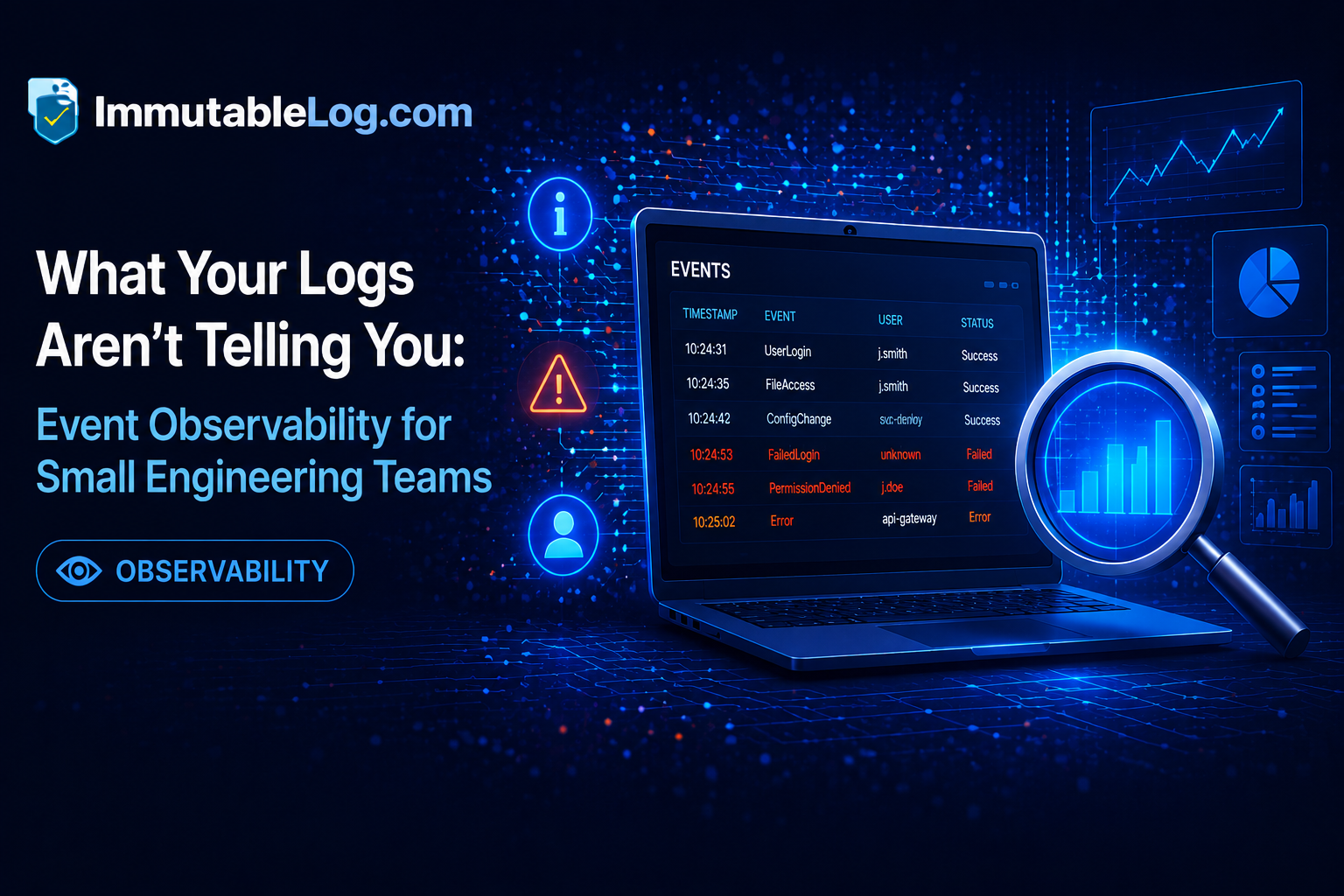
Understand what is happening in your software.
Identify suspicious or relevant behavior.
Reconstruct who did what, when, where, and on which resource.
Cryptographically verify that the evidence remained intact.
Trust used to be assumed. Today it must be demonstrated to regulators, customers, courts, and increasingly, to AI oversight bodies.
EU AI Act, NIST AI RMF, ISO 42001, and emerging national frameworks share one demand: organizations must produce verifiable records of automated decisions and the data behind them.
SOC 2, ISO 27001, LGPD, and sector-specific frameworks have shifted from "document your controls" to "prove they were applied." Self-reported logs are no longer sufficient evidence.
Privileged users with the ability to alter their own audit trail remain the highest-impact threat. Independent, tamper-evident records provide stronger evidence for audits, investigations, arbitration, and legal disputes.
Each of these is a publicly observed pattern across enterprise incidents. None required a sophisticated attacker: only a system where the same people generating the logs could also alter them.
An employee with admin credentials accesses millions of records over an extended period. The activity is technically logged, but the same role can edit, rotate, or rebuild those logs. By the time investigators arrive, the trail is partially gone.
An auditor requests a year of access events for a critical asset. Logs were rotated, partially purged, and split across infrastructure managed by different teams. Reconstruction takes weeks and produces partial answers, which regulators interpret unfavorably.
A customer disputes a transaction or configuration change executed long ago. The application logs are intact, but they live on the same systems the customer is questioning. There is no record they would consider neutral.
These are not edge cases. They are the moments when the absence of cryptographic evidence becomes expensive.
Every sealed event is normalized to ECS, geolocated by the real user's IP, cross-referenced with threat intelligence, and evaluated by detection rules, all without ever losing the immutability proof.
meta.client_ip becomes source.ip with maximum precedence, so geo, threat and detection run on the actual user, not the proxy.
Country, city and coordinates for every event, cross-referenced with threat feeds to surface risky IPs.
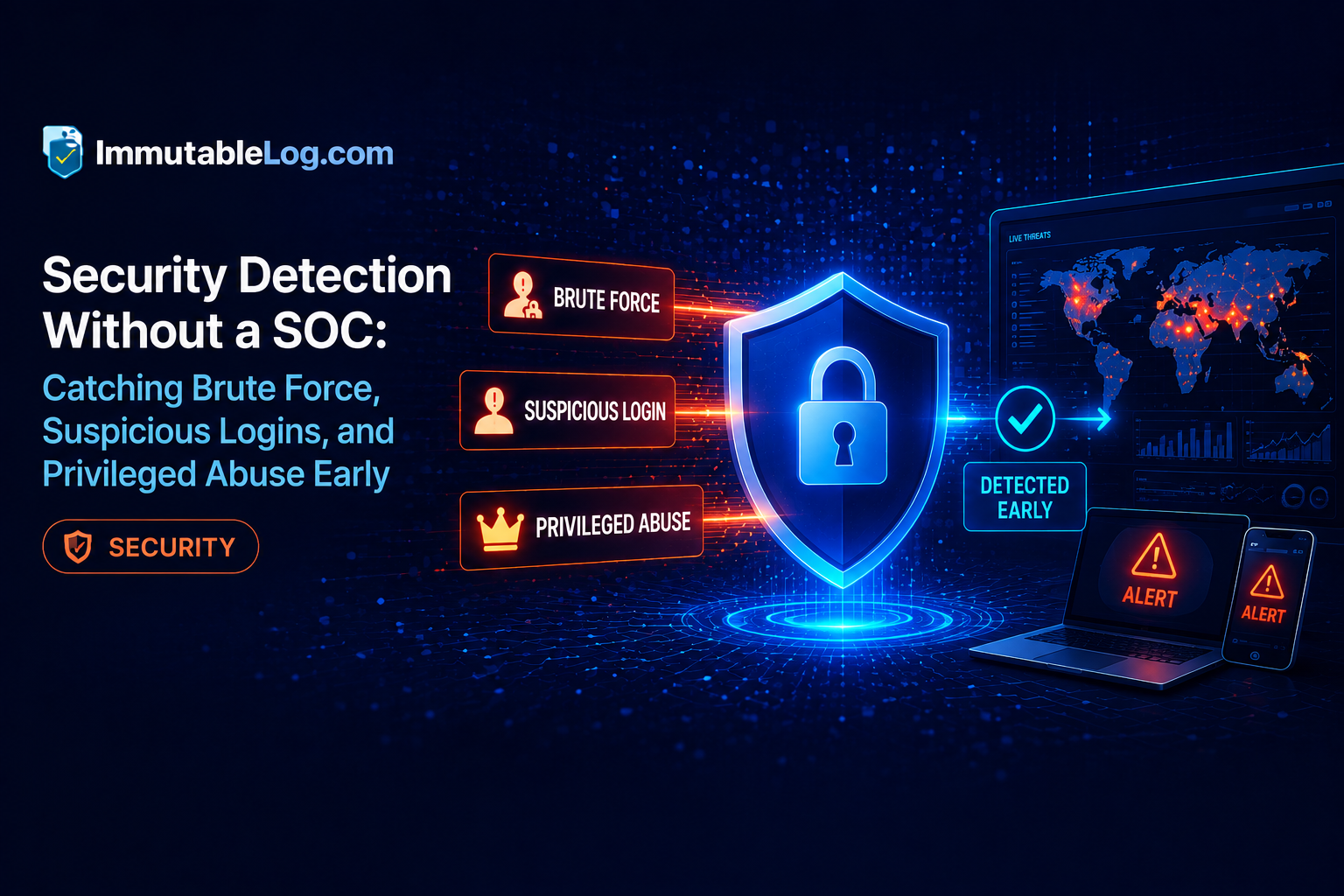
Brute-force, new-IP, threat hits and more: detections raised per tenant and linked back to the exact event.
Between the browser and the core there are proxies and load balancers. Your backend forwards the browser's real IP in meta.client_ip, and the SIEM writes it to source.ip with provenance client_asserted.
44.192.13.3
AWS proxy179.110.4.205
real userThe core seals it. The SIEM reads and enriches it.
What we already detect today
Repeated failed logins from the same IP, the signature of a scan or a brute-force attempt.
The same user logs in and deletes data right after, a pattern consistent with a compromised account.
A login from an IP never seen before for that tenant, flagged the first time it happens.
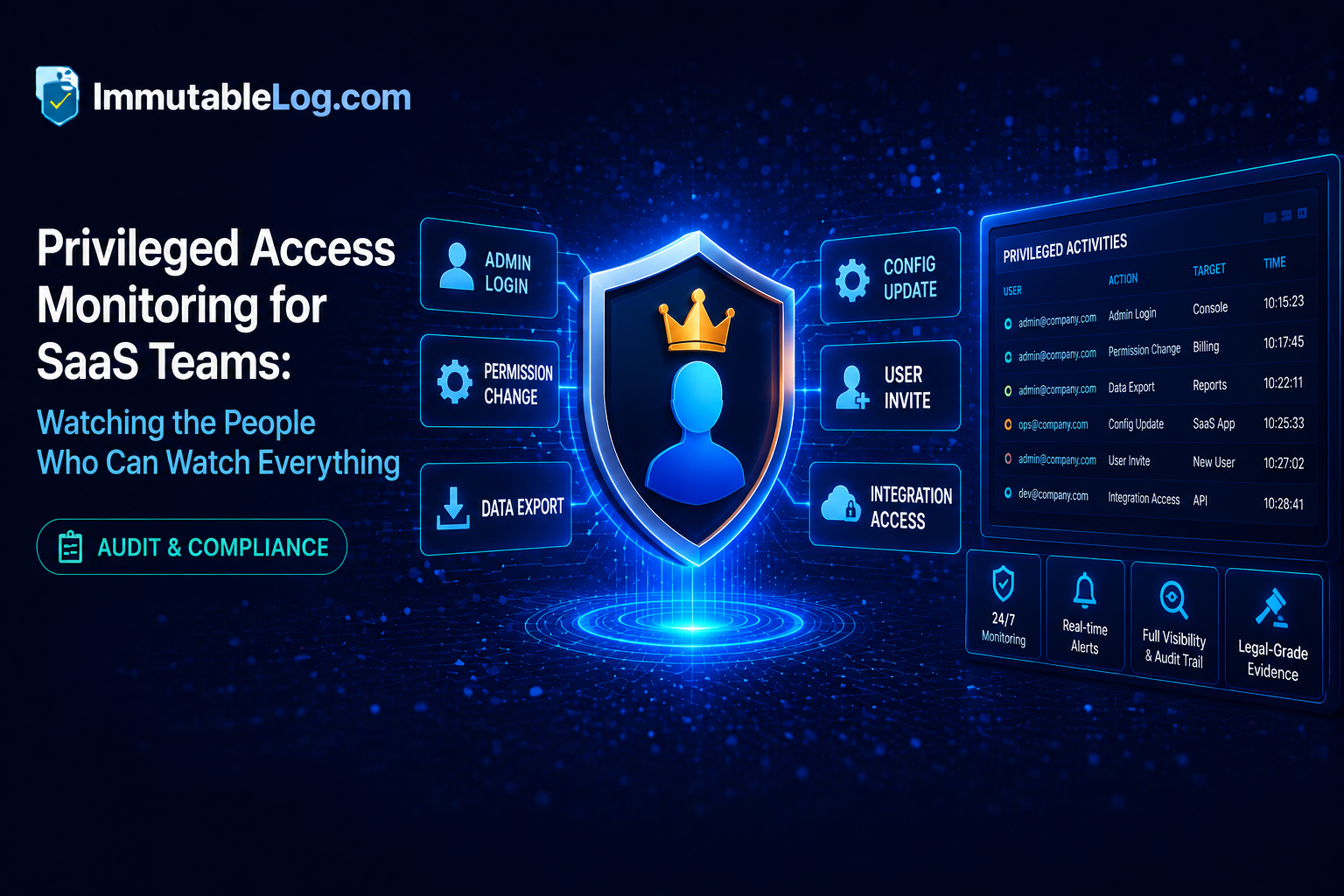
Every authenticated action by a root or admin user is tracked, since it should be rare and always reviewed.
Traffic touching an IP flagged by reputation feeds such as Spamhaus, Tor exits or known compromised hosts.
Repeated 401 responses from the same IP, the pattern of a credential scan against the API.
Repeated 403 responses for the same user, an account reaching for what it isn't allowed to touch.
Traffic from a country never seen before for that tenant, an unusual shift in where requests come from.
An unusual surge of errors in the customer's production environment, on the same service, a signal an incident is under way.
Every sealed event carries the context to reconstruct it fully: who acted, what they did, on which resource, and where the trail continues. No reconstruction across five systems, no scrambling before an audit.
Filter by actor, service, environment, or time range, then export the trail for the auditor, the regulator, or your own investigation.
Trace exactly what changed in production and who triggered it, without digging through five different systems.
Reconstruct the full sequence around an incident: actor, action, and every related event in context.
Answer "who did what, when" with an exportable, verifiable trail instead of a self-reported log.
Hand auditors a filtered export instead of a week of manual reconstruction.
ImmutableLog is a security, audit, and event observability platform built on a private, permissioned cryptographic ledger. The SIEM helps you observe, enrich, detect, and investigate. The Core preserves the original evidence and makes its integrity cryptographically verifiable.
Private ledger: events remain within your environment. No public blockchain.
Append-only immutability: events cannot be edited or deleted once written.
Cryptographic proof: every event is verifiable through deterministic hashing.
Independent verification: anyone can recompute the inclusion proof, and consensus across multiple nodes means no single node can rewrite history on its own.
ImmutableLog is not a public blockchain. It does not use cryptocurrency or tokens. It is infrastructure for proof: making your event history verifiable and auditable.
Retention locks, WORM and IAM policy are configuration, turned off by whoever holds admin. The question isn't "is it locked?", it's "locked against whom?".
The three questions a configuration lock can't answer
A lock the admin can revert doesn't protect against the insider with credentials: the attacker who erases their own trail first.
If a record was altered, can you detect which one and prove it? Hash-chain proves. Configuration only tries to prevent.
Not the platform itself. Multi-validator consensus distributes trust, so no single node rewrites history.
ImmutableLog doesn't prevent tampering by policy. It makes tampering mathematically detectable and verifiable by third parties.
Every critical event passes through seven stages before it becomes proof. None of them is optional: that's what separates a log from an audit trail. The Core preserves first. The SIEM analyzes after.
Your application sends a critical event (a user action, configuration change, transaction, or automated decision) through an authenticated POST.
The event is validated against schema and signature. Invalid payloads are rejected before they touch the ledger.
The event is replicated across the cluster nodes. No single node can unilaterally decide what enters the chain.
Nodes agree on the order and content of the event before accepting it. No consensus, no record.
A deterministic hash links the event to the previous block, forming a chain where altering the past breaks the entire future.
The block is written to append-only storage. Events cannot be edited or deleted, not even by administrators.
Auditors, regulators, or your own systems can cryptographically prove the event happened, months or years later.
# Record a critical event
curl -X POST https://api.immutablelog.com/v1/events \
  -H "Authorization: Bearer YOUR_TOKEN" \
  -H "Content-Type: application/json" \
  -d '{
    "event_type": "admin_access",
    "actor": "admin_01",
    "action": "delete_database",
    "timestamp": "2026-01-30T14:20:00Z"
}'It's about turning critical events into visibility, detection, audit trails, and verifiable evidence.
Inspect sealed records, navigate the chain of proof, and export cryptographic evidence from a single audit interface.
The Evidence Ledger shows every sealed record with its block reference in the chain. Export to CSV or search by name and payload.
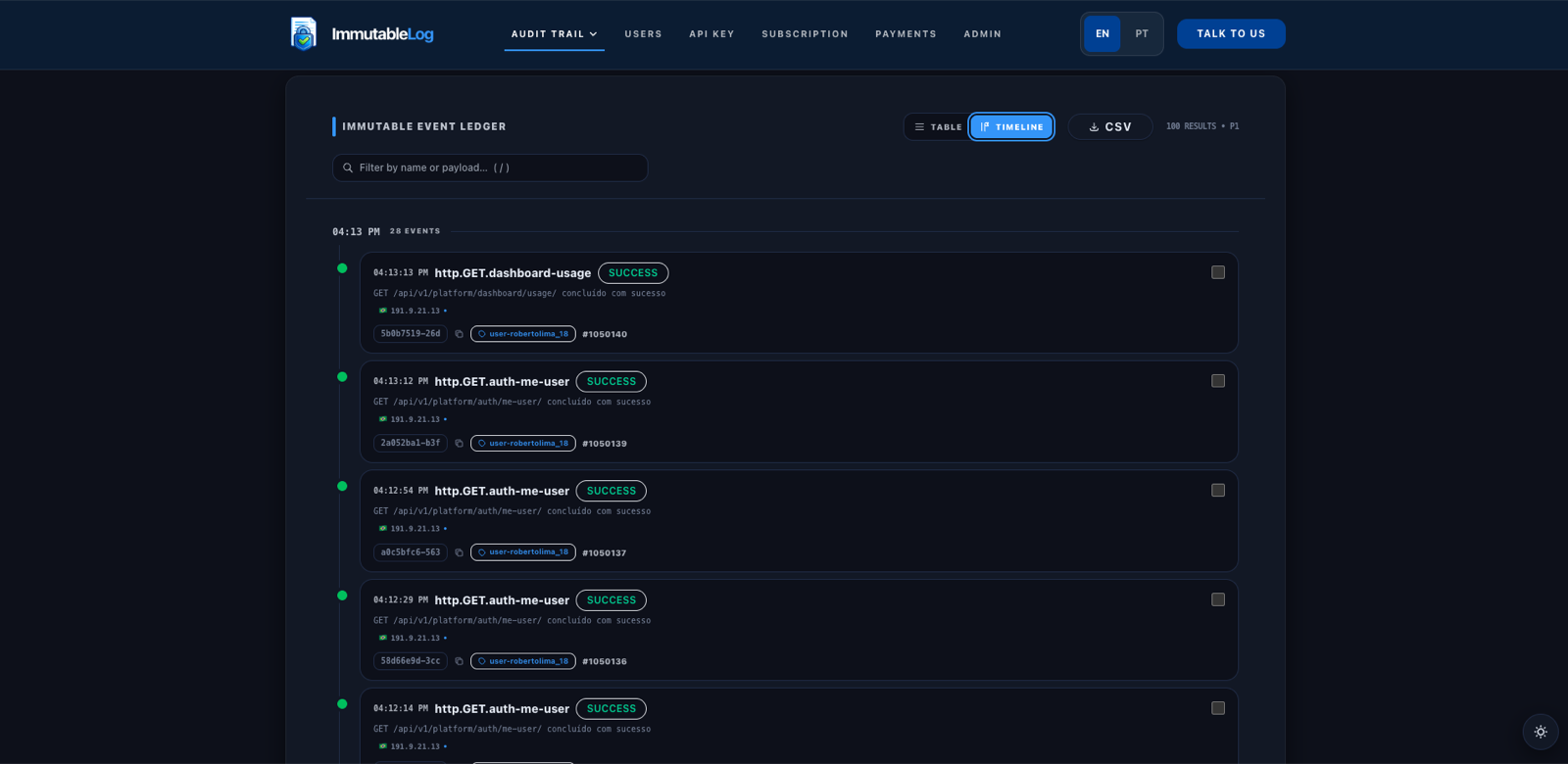
This is the evidence-focused view of the platform, built for audit, export, and verification.
Every organization has moments of exposure. These are the ones where cryptographic evidence changes the outcome.
A support lead in your SaaS platform can grant refunds, change plan tiers, and disable other users' accounts. Six months later, a customer disputes a refund that was never approved.
Customer Success Ops · CTOImmutableLog's SIEM surfaces every admin action as it happens, who did it, from where, on what account, so your team can investigate immediately. Each action is also cryptographically sealed into the chain when it is recorded, along with proof of inclusion, so the record stands even if the admin account itself is compromised later.
Your monitoring shows a spike in failed logins against a customer-facing API. Is it credential stuffing, a misconfigured integration, or a customer who forgot their password?
Security Lead · EngineeringImmutableLog's SIEM detects the pattern, source IP, velocity, targeted accounts, and raises an alert your team can act on within minutes. Every authentication event behind that alert is stored as a tamper-evident record, so the investigation rests on verifiable evidence, not a dashboard screenshot.
A prospective customer's security team asks for your audit log retention policy and a sample export before signing. Your logs are scattered across three services, none of them tamper-evident.
Sales Engineering · ComplianceImmutableLog gives you one continuous, filterable audit trail across every service that sends events. When the request comes in, you export a package with cryptographic proof of integrity attached, not a CSV you have to vouch for.
A support engineer at your healthtech is suspected of viewing patient records outside their assigned cases. The application logs that would prove it are controlled by the same team the engineer belongs to.
CISO · Legal · HRImmutableLog ingests access events independently of your application's own logging path, so the record isn't something the team under investigation can quietly edit. Legal and HR get a timeline they can verify cryptographically, not one they have to take on faith.
A DBA or infrastructure engineer at your insurtech has production database access and, in principle, the ability to cover their own tracks. How do you prove, to an auditor or to yourself, what they actually touched?
IT Governance · CISOImmutableLog's SIEM flags privileged actions as they happen, queries against sensitive tables, config changes, credential use, and each one is sealed before it reaches your systems, independent of the admin and independent of the database. Any auditor can verify it without trusting your word.
LGPD, SOC 2, ISO 27001, and sector regulators require you to prove, not just claim, that controls were applied. Self-reported logs from your own systems aren't enough on their own.
DPO · Compliance LeadImmutableLog's SIEM gives your compliance team the day-to-day view of controls in action. Every underlying event also carries a cryptographic proof of inclusion, so when a regulator asks for evidence, you hand over something independently verifiable, not a report they have to take at your word.
Your ERP SaaS exposes a partner API. One integration partner starts pulling far more records than their contract allows, or an API key leaks and someone else starts using it.
Platform Engineering · SecurityImmutableLog's SIEM correlates API key, endpoint, volume, and origin to flag abnormal usage as it happens. Every API call tied to the incident is already an immutable, cryptographically sealed record, so your response rests on evidence, not reconstruction.
A configuration change in your HRTech's deployment pipeline breaks payroll calculations for a client. Was it reviewed? Who merged it? Was it the change that shipped, or a later one?
Platform Engineering · Engineering LeadershipImmutableLog's SIEM gives you the timeline of every deploy, config change, and approval as it happens. Each event is cryptographically sealed into the chain at ingestion, so the sequence you show the client, or use in a post-mortem, can't be quietly edited after the fact.
The audit doesn't announce itself. Your evidence layer should be ready when it arrives.
ImmutableLog is built for organizations where verifiable evidence is not optional.
Payment fintechs, lending platforms, digital banks and payment operators regulated by BACEN. Resolution 4.893 requires immutable records of critical operations and access logs.
Telepsychology, telepsychiatry, and digital health platforms handling sensitive medical records. CFM Resolution 1.821 requires immutable clinical documentation.
Notary offices, registry offices and extrajudicial services regulated by the National Council of Justice. CNJ Provimento 213/2025 mandates digital audit trails.
Legal management platforms, arbitration chambers, and digital law firms. Evidence of process integrity and decision traceability is required in legal disputes.
Federal, state, and municipal bodies subject to Brazil's Access to Information Law and TCU audits. Immutable records are essential for transparency and public accountability.
Insurance companies, insurtechs, and health plan operators regulated by SUSEP and ANS. Immutable records of claims, policy changes, and fraud investigations are essential for regulatory compliance and legal disputes.
Does your industry require provable audit history?
ImmutableLog gives compliance and audit teams a continuous, tamper-evident trail: retained on your terms, filterable on demand, and exportable as a verifiable evidence package that strengthens your audit and compliance processes.
Mapped to controls auditors already know
Integrity measures: history that cannot be altered without detection.
Protection of the audit trail against unauthorized modification.
Protection of log information against tampering and improper access.
Cryptographic protection of the audit trail, delivered by the hash-chain.
Articles on audit, compliance, cryptography, and immutable infrastructure.
Bring observability, security detection, audit trails, and cryptographic evidence together in one platform.